
Read the Scott County Property Tax Record
Scott County's Tax Assessor/Collector runs both appraisal and collection. The public Delta Computer Systems county landing page splits its tools into real-property tax, appraisal, personal property, mobile homes, GIS, and payments. Pick the right field first. Treating the whole tax card as one number is the classic mistake, so match each question to its own line.
| Field | What It Shows | Where |
|---|---|---|
| LANDVAL | Land component in the parcel layer | Assessor/GIS |
| IMPVAL1 and IMPVAL2 | Improvement-value components | Assessor/GIS |
| TOTVAL | Total tax-value field, not a deed price | Assessor/GIS |
| TAXYEAR and TAXSTATUS | Year and status tied to the tax record | Assessor/GIS |
| Bill and payment | Amount, installment, interest, or payment context | Tax Collector |
Mississippi separates true or market value from assessed value. State rules apply a class ratio to true value first. Millage then converts assessed value into the actual tax. A deed's consideration answers a different question entirely. Delta results can order fields differently, so keep the tax year and parcel number with every saved record.
Search Scott County Property Tax in Delta
The Scott County real-property tax form offers several ways into the roll. Always use the narrowest reliable key. A PPIN helps when a road name varies. Section, township, and range can rescue a rural search that has no clean street match or mailing city agreement.
| Search field | Input | Practical use |
|---|---|---|
| Name | Last, first text | Find parcels associated with an owner spelling |
| Address | Number and street | Find the situs parcel |
| Parcel Number | Parcel text | Match a known PARNO |
| Section / Township / Range | Survey-grid text | Narrow rural land |
| PPIN | Integer identifier | Cross-reference Delta and GIS |
This image shows the official Delta tax-search form for Scott County. Open the live Scott County tax search before relying on the interface.
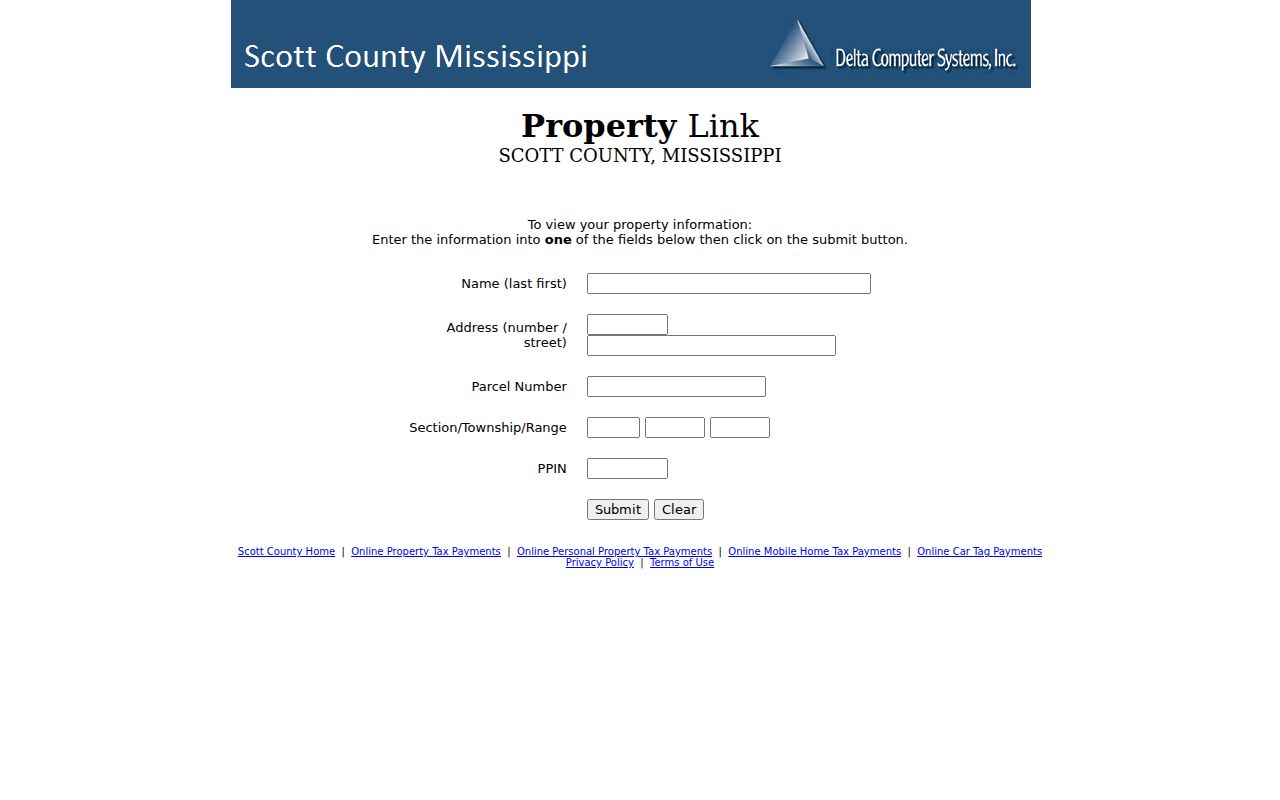
The form confirms the available search modes. It shows no parcel balance until you open and read a matching result.
Note: Delta and GIS do not publish a normal refresh interval, so record the search date with any saved Scott County result.
Scott County Property Tax Follows a January 1 Owner Rule
Mississippi taxes the January 1 owner of record for each tax year. That date controls everything. Scott County sets the first-half installment due February 1 after the tax year. Later installments can draw one percent interest monthly. A March deed does not change that year's roll. Title and liability can sit with different people that year.
Date check. Compare TAXYEAR, the GIS deed date, and the newest recorded deed before treating the tax-roll owner as today's title holder.
The Mississippi Department of Revenue tax guidance covers the statewide calendar. The Scott County Collector settles any live bill, installment, or interest question.
Scott County Values Become Tax Through Millage
The state property-appraisal guide lays out the sequence in three steps. Estimate true or market value first. A statutory class ratio produces assessed value, and millage produces the tax: Class I owner-occupied residential at 10 percent, Class II real property at 15. Those ratios are not sale prices.
- True or market value
- The assessor's estimate of full value under Mississippi appraisal rules.
- Assessed value
- The value after the applicable class ratio is applied.
- Millage
- The levy applied to assessed value to calculate tax.
- Homestead exemption
- Qualified relief tied to an eligible home and application.
- Tax lien
- A claim tied to unpaid property tax, distinct from a completed title transfer.
Keep appraisal, class, exemption, millage, and bill on separate lines. A careful Scott County property tax review never blends value with amount owed.
Scott County Homestead Runs January Through April
The Scott County Assessor/Collector administers homestead assistance. Applications run January 1 through April 1. First-time applicants must apply in person, and a new application is required whenever ownership, use, or occupancy changes. The Mississippi homestead page gives the state framework. The local office decides the Scott County file. Bring the parcel identifiers. A reduced bill alone does not prove an exemption. Never assume an old exemption survived a deed or an occupancy change. The office at 100 E First Street in Forest handles appraisal and collection together, making it the best place to reconcile the tax card and the application.
Note: Reapply after an ownership, use, or occupancy change; an old Scott County exemption should not be presumed to transfer automatically.
Look Up a Scott County Property Tax Bill
A bill check is a reconciliation, not one lookup. Start in Delta. Keep the exact parcel, and compare assessment fields against collection fields before paying or judging delinquency.
- Search Delta by address, PPIN, parcel number, owner, or section/township/range.
- Confirm that the situs, owner, and tax year describe the intended parcel.
- Read the value components and check whether an exemption appears in the local record.
- Ask the Collector to confirm the live balance, installments, interest, and any sale status.
- Search Chancery tax-sale and release books if delinquency has entered the recorded-land trail.
The Delta menu separates tax inquiry, appraisal, GIS, and payment. Check the official Scott County Delta menu for the current route.
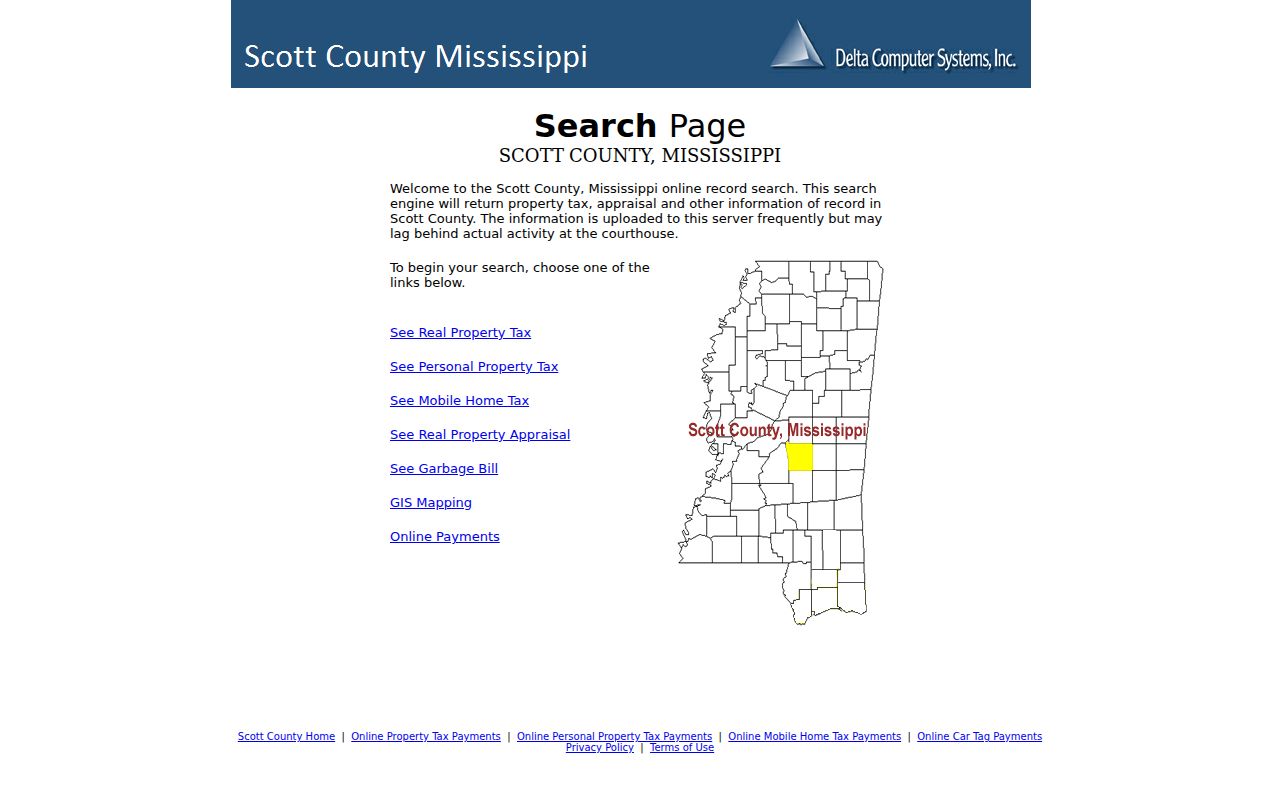
The menu picks the right system. A balance can shift after any page loads, so the Tax Collector remains the source for the current amount owed.
Scott County Tax Sales Need a Status Check
Scott County may hold an annual tax sale. The recorded-land portal organizes the results into Tax Sale and Tax Sale Release books, plus separate municipal tax-sale books for Forest, Morton, Lake, and Sebastopol. Searches run by parcel, owner, purchaser, legal description, or tax year. A listing or certificate is not a final deed. Some sales end in a release instead. Redemption goes through the Chancery Clerk at 601-469-1922. Verify the tax year, purchaser, redemption date, release, and any deed or court order against the current roll. State guidance places sales on the first Monday in April or the last Monday in August. No current Scott County sale list or publication page appears online. Ask the Collector for the actual calendar.
Note: Treat delinquency, tax sale, redemption, release, and ownership transfer as separate stages until the responsible Scott County offices confirm each one.
Request Missing Scott County Property Tax Records
Start with the Assessor/Collector when the public portal leaves a prior card, bill detail, or status out of reach. That office holds the working records. Some items simply have no published online path. For those, print and sign the Scott County public-records request form. Give the PPIN, PARNO, situs, and legal description. Add the record type and date span.
The signed request routes to the Chancery Clerk. That clerk serves as public-records officer. Costs can follow. The county may estimate search, reproduction, delivery, and legal-review charges, and it can require payment before producing anything. Its procedure allows seven business days for a response or a written estimate. Production then follows within fourteen business days unless the requester agrees to more time. If copy charges worry you, ask to inspect the records instead.
Say exactly what you want. An assessment card, a tax-roll extract, a payment record, a delinquency record, and a tax-sale instrument may sit with different functions even though Scott County combines assessor and collector duties. Name the tax year, too. A current parcel number alone never shows which year's valuation or liability is in dispute. If the request involves a recorded tax sale or release, include the Chancery book, page, or instrument number when you have it.
Challenge a Scott County Property Tax Assessment
Mississippi's tax calendar builds in a review window. Owners can review the roll and object first, before the assessment becomes final. The Department of Revenue sets the first Monday in August as the key date. That is when the board reviews assessments. Confirm the current Scott County notice and filing steps with the Assessor. The county publishes no separate local appeal form online.
Start with the parcel, tax year, class, and exemption. Break out the land and improvement components as well. Then gather proof that fits the dispute. Useful items include a recent appraisal and photographs of condition problems. A survey, comparable sales, or the deed and plat can fix a description error. Keep a copy of your submission and proof of delivery.
Appeal window. Contact the Scott County Assessor before the first-Monday-in-August review point and verify the current board deadline, required format, and hearing date.
A value challenge turns on the assessment evidence. Bill questions, interest, and payment matters belong with collection staff. For help reading the value fields, see the Scott County property value guide.