
Read Scott County's Owner-of-Record Card
Scott County's official GIS schema lists every field on the mapped parcel card. The owner appears in OWNNAME. Around it sit separate site and mailing addresses, deed references, the tax year, and the parcel identifiers, so each piece of the ownership record stays distinct.
| OWNNAME | The mapped owner label |
|---|---|
| MAILADD and mailing fields | The address used for owner mail |
| SITEADD and site fields | The parcel's situs address |
| PPIN and PARNO | Keys used to confirm the same parcel |
| DEEDREF and DEEDDATE | Pointer and date for the related deed |
| TAXYEAR | The year framing the tax-roll data |
The record card has limits. It says nothing about tenancy terms, occupancy, or complete title. For the real grantee language and legal description, a property search should end at the deed image itself.
OWNNAME Is Scott County's Exact Current-Owner Field
The county states that the Assessor maintains current ownership maps. It publishes no set refresh schedule, though. The statewide parcel layer confirms that OWNNAME is the mapped field. Delta's appraisal search offers name, address, parcel, and PPIN routes to an owner card. The form itself displays those entry fields. Open the current Scott County appraisal search and start with the narrowest key you know.
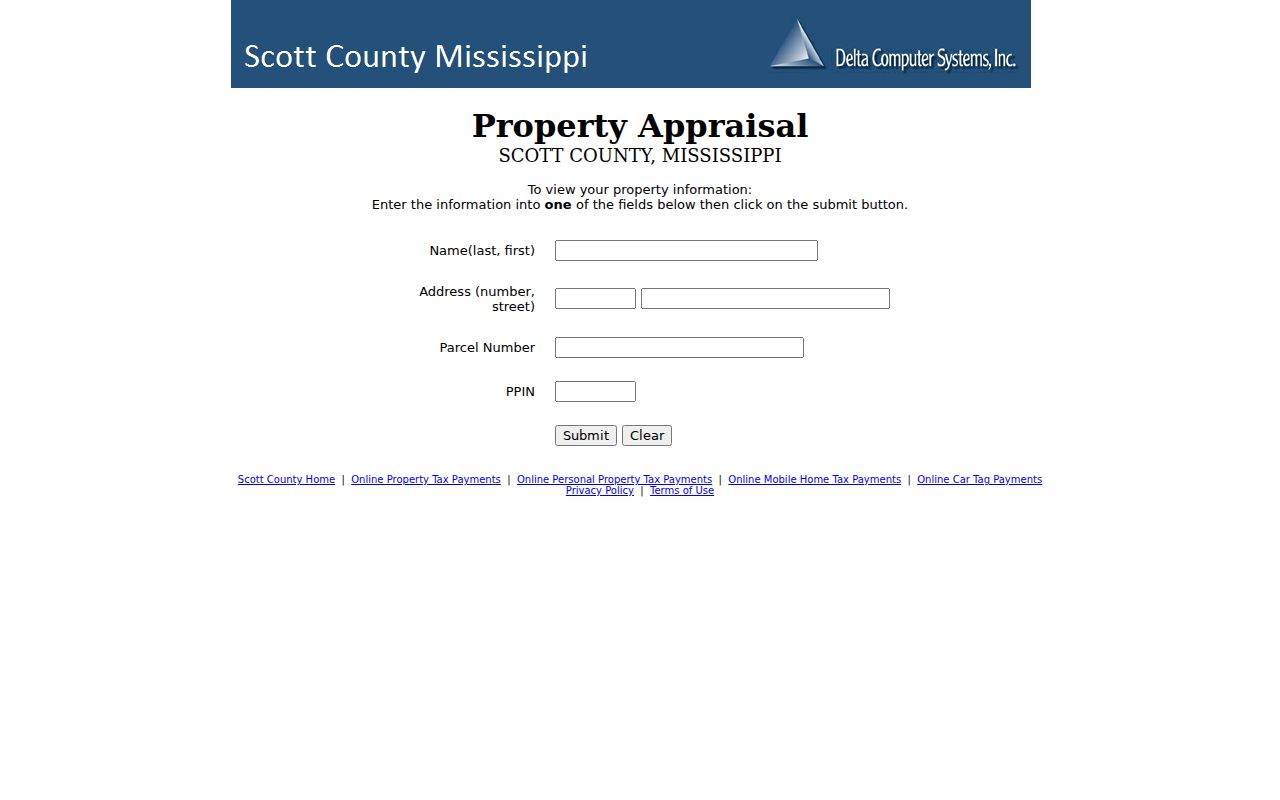
Those fields let a search begin with a name, address, parcel number, or PPIN. The matching card still deserves a deed check before anyone treats the owner as settled.
Separate Scott County Owner Mail from the Situs
The mail fields, MAILADD1 through MZIP1, show where Scott County sends notices. The site fields, SITEADD through SZIP, locate the real property itself. Owners often receive mail elsewhere. A different city is common. A post-office box is common too. Neither is evidence that the owner field is wrong. This split works as a geographic safeguard too. A Forest postal label does not prove a parcel sits inside Forest's incorporated limit. Preserve both addresses. Then lean on the parcel geometry and legal record for location. Use the public mailing line only for legitimate property-related contact.
Note: A Scott County mailing address is a notice route, while a situs address identifies the property; neither one proves who occupies it.
January 1 Can Differ from Scott County's Current Owner
Mississippi assesses property tax to the January 1 owner of record. A sale later in the year can leave the seller tied to the tax roll. Meanwhile, the newest deed names the buyer. That gap is a matter of time frames. It is not enough, on its own, to call either record false.
Recent-sale check. When the roll and deed differ, compare TAXYEAR, DEEDDATE, the recording date, and the newest grantee before naming the current owner.
Scott County publishes no typical deed-to-roll delay. Ask the Assessor to check the ownership map instead of assuming updates take a fixed number of days.
Confirm Scott County's Current Owner Against the Deed
An owner-card check should end at the newest relevant recorded instrument. Use the parcel keys throughout, so a shared name or mailing address does not pull the wrong deed.
- Search Delta appraisal records and capture OWNNAME, PPIN, PARNO, and situs.
- Use DEEDREF or search DuProcess by To/Grantee, parcel, PPIN, or street.
- Open the newest deed and compare grantee, legal description, date, and related instruments.
- Ask the Assessor about a just-recorded deed that has not reached the map.
- Owner of record
- The party shown by a stated official record at its date.
- Assessment roll
- The tax record carrying the parcel, owner, and value for a tax year.
- Recording lag
- The unpublished interval between deed filing and another system's update.
- Registered agent
- An entity contact, not automatically the land's beneficial owner.
DuProcess labels its online data as informational and treats the courthouse index as controlling. The portal does not offer certified copies online.
Read a Scott County Entity Owner in Present Tense
When OWNNAME names an LLC or corporation, the Mississippi business search can confirm the exact entity name, status, officers, and registered agent. Those people add entity context. They are not automatically the title owner. A trust or estate may call for a recorded deed, a will-related instrument, an administrator's deed, or a Chancery order. Never substitute a beneficiary, trustee, heir, officer, or occupant for the grantee. The record itself must support that conclusion.
Resolve an Unchanged Scott County Owner Roll
Call the Tax Assessor/Collector at 601-469-4051 with the PPIN, PARNO, DEEDREF, and recording date in hand. Ask whether the office has received the conveyance. Ask whether it has been processed for the current ownership map. For the controlling index or a copy, call the Chancery Clerk at 601-469-1922. If a county-held card or map must be produced, submit the Scott County public-records request. State the parcel, record category, date span, and inspection choice. The county may estimate actual search, copy, delivery, and legal-review costs.
Note: Record both the search date and portal tax year when documenting a Scott County current owner, since neither system promises instant updates.
Get Scott County's Newest Owner Instrument
The Chancery Clerk records deeds, deeds of trust, liens, lis pendens, and plats. Tax-sale material and related land instruments are filed there too. DuProcess shows indexed detail and scanned images. Online copies carry a 3.5 percent service fee with a $2 minimum. The portal does not offer certified copies online. Request an official copy from the Chancery Clerk, PO Box 630, Forest, MS 39074. For an older or missing instrument, try the Virtual Index, courthouse books, or MDAH. Don't assume a firm online cutoff. A thorough deed review notes the instrument number, file date, grantor, and grantee. Include the legal description, parcel or PPIN, and consideration. Book and page and related instruments matter too. Confirm the item is actually a deed. A deed of trust, release, lien, plat, or notice can look similar at a glance. The same owner name can also appear in several legal roles. DuProcess displays records verified through September 9, 2026 and updates daily except weekends and holidays. That verification date does not promise every field is complete. The portal caps web results at 8,000. Narrow a common-name search with date, instrument type, parcel, legal description, or street.
Document a Scott County Current-Owner Finding
Write down what you actually consulted. A solid current-owner note lists the Delta or GIS search date along with OWNNAME, TAXYEAR, PPIN, PARNO, situs, and mailing address. It also includes DEEDREF and DEEDDATE. Scott County systems give you the newest deed too. Capture its grantee, instrument number, recording date, and legal description. When two sources disagree, say how they differ. Never just pick one quietly.
Some situations need extra care. A recent closing splits the record. January 1 tax ownership and present deed ownership answer the question on different dates. For an LLC, write the entity's exact legal name and state filing status, and stop there. Its agent is not the owner. For a trust or estate, keep the capacity shown in the deed and note any Chancery instrument. Keep everything in present tense. That stops the note from drifting into a chain of prior ownership nobody has verified.
The assessment roll is a lead, not a verdict. A purchase, inheritance, boundary dispute, or encumbrance question calls for reviewing the recorded instruments. Get qualified title help too. Scott County property records are valuable. They pin down the parcel and the latest indexed transaction. But they do not produce a title opinion.
Use Scott County Current-Owner Data Lawfully
The public mailing field in Scott County property records opens a formal channel. Use it for a purchase inquiry, a boundary question, an estate matter, or notice about the property. It does not permit unwanted contact, and confidential-address or sealed-record protections may still limit disclosure.
Lawful use. Contact a Scott County owner only for a legitimate property matter. Never use owner or address information to stalk, harass, intimidate, or harm anyone.
Remember the limits. The roll is not proof of occupancy, and the owner name is not a title search. For the broader address-to-owner route, use the Scott County property owner method.