
Scott County Owners in Reverse
A backward chain moves from grantee to grantor. Each deed names the prior seller. The DuProcess land index for Scott County is the first web source for this work, and it accepts grantor and grantee names, book and page, instrument number, parcel or PPIN, street, subdivision, and legal-description details. Those fields keep a chain anchored. The portal states no earliest online year, so it cannot prove that every former owner is indexed on the web.
| Source | Years It Covers | Where Held | What It Shows |
|---|---|---|---|
| Transfer Date | Grantor to Grantee | Deed Type | Book/Page |
| Newest recorded date | Seller to current grantee | Read the instrument label | Copy both reference parts |
| Prior recorded date | Earlier seller to that grantor | Check deed subtype | Match the same tract |
| Repeat backward | Each grantor becomes the next grantee search | Note corrections or estate deeds | Keep a running citation |
A working timeline is a ledger, not proof. Each row needs the legal description, instrument number, and any related instruments. Names repeat, and one deed can cover several tracts. Keep Scott County previous owners linked by land description and recorded references rather than by name alone.
Find Scott County's Starting Deed
Identify the current parcel first. The Delta assessor search or county GIS works. Save its PPIN, PARNO, deed reference, situs address, and legal description. Then locate the newest deed in DuProcess by placing the current owner in the To/Grantee field. A common name can flood the results. Add a filter instead of guessing, using a parcel, subdivision, street, date, or instrument constraint.
Read the deed image when it is available. Record the exact grantor and grantee spellings, file date, instrument number, book or reel, page or image, deed type, legal description, and any cross-reference. Trusts, estates, companies, and multiple grantees can carry names that differ from the assessor label. The recorded text bridges to the next link.
The DuProcess search form displays the many fields that can narrow Scott County prior owners.
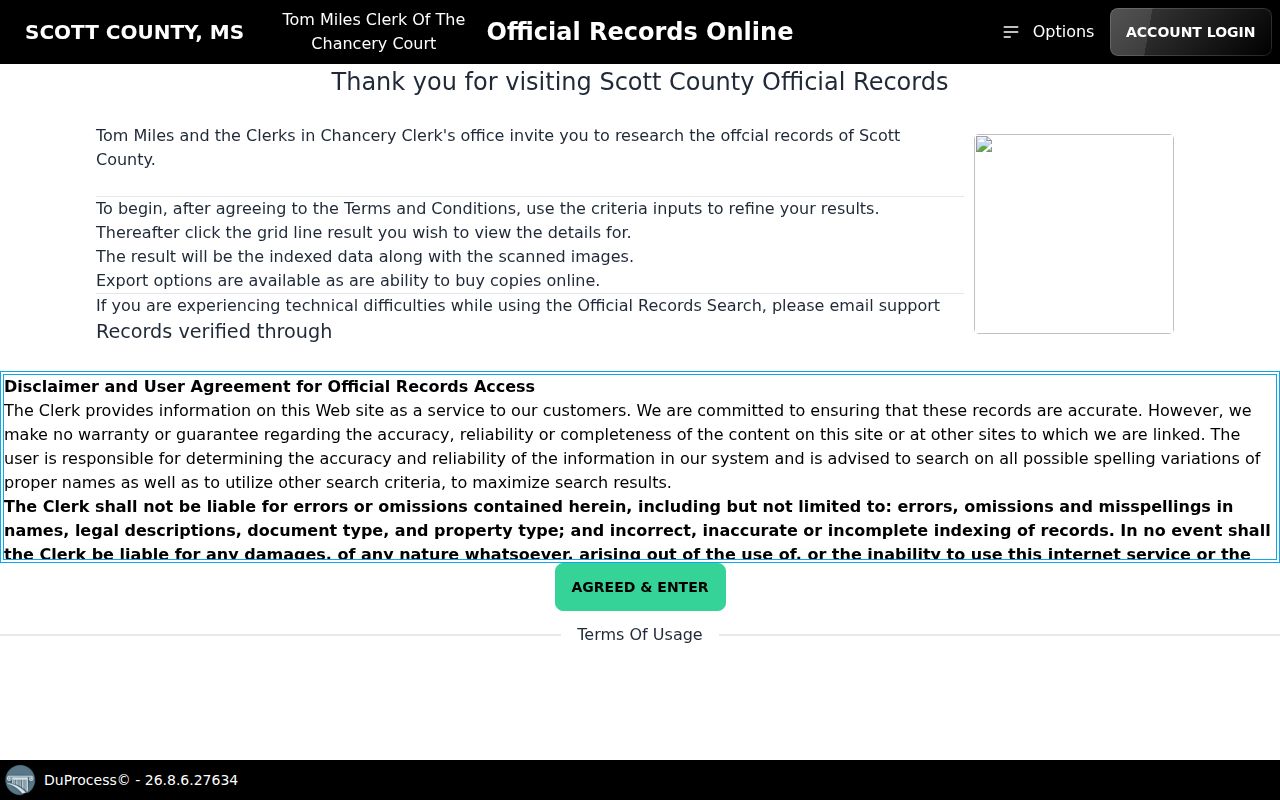
The party, legal, address, and book fields stay separate. That lets you test a Scott County deed chain without treating a loose name match as the same parcel.
Reconstruct Scott County's Deed Chain
Work in a fixed order. The aim is to learn how each grantor acquired the same tract while guarding against unrelated deeds filed under the same name.
- Open the current grantee's acquisition deed and copy the grantor name exactly.
- Search that grantor in the To/Grantee mode to find when the grantor acquired the land.
- Compare legal description, parcel clues, acreage, and book/page before adding the transfer.
- Make the earlier deed's grantor the next grantee search, then repeat.
- Inspect corrections, releases, plats, and related instruments without mistaking them for a change of owner.
- Grantor
- The party conveying an interest in the recorded deed.
- Grantee
- The party receiving that recorded interest.
- Chain of title
- The ordered series of recorded transfers for the same land.
- Reverse index
- An index organized to find grantors as well as grantees.
- Quitclaim and warranty deed
- Different deed forms; either label still requires reading the instrument and its legal description.
Older Scott County Owners Online
Older owners need a different door. The ordinary search states no earliest year. Scott County offers a separate Historic Virtual Index organized by record type, book, and page, with navigation and scanned-image controls. It opens a route into older volumes. Even so, it promises neither full name indexing nor digitization of every historic owner, so book citations carry the weight.
Citations carry real weight in Scott County deed research. A book and page reference pulled from the most recent reliable deed can unlock an image even where an address or a modern parcel number comes up short.
Online limit. Scott County does not publish the earliest DuProcess year; continue in the Virtual Index, courthouse books, or archives when results stop.
Plats Keep Scott County Chains Aligned
Streets get renamed and parcel numbers get redrawn. A lot, block, section, township, or range description can outlast them all. DuProcess includes Official Plat Book and subdivision filters. The GIS layer adds PLATREF, PLATDATE, SUBNAME, and SUBDIVNO. Treat those fields as pointers to the recorded plat rather than substitutes for it.
Chains often look broken. A subdivision, split, consolidation, or correction can explain the gap. Compare the old deed's legal description with the recorded plat and the later parcel card. Scott County labels such as Forest Original Town, Morton Heights, and Town of Sebastopol are useful index clues. The dropdown label proves nothing by itself.
Note: Keep the old and new parcel identifiers beside the deed citation whenever a tract changes shape or numbering.
Estate Paths to Scott County Owners
Death can interrupt a neat buyer-to-seller chain. Scott County Chancery Court handles estates, guardianships, and conservatorships. The land portal also exposes Will and administration, executor, and guardianship book categories. Search the decedent, estate, personal representative, and heir names, then look for an administrator's deed, quitclaim, order, or affidavit. A death alone never updates the assessor's owner field. Tie each change to the deed or court order. Compare its legal description with the parcel. Chancery case access through the Second Chancery District MEC adds context, though login and sealed-record limits apply.
Scott County Owners at MDAH
Old paper trails leave the courthouse eventually. The Mississippi Department of Archives and History finding aid covers Scott County material dated 1821 through 1995. It lists original and microfilmed formats, including probate copies from 1832 through 1862. That span reaches the county's 1833 formation era. The trail can reach past the portal. Note the format of each item, since original, copy, transcript, abstract, box, and microfilm roll differ. MDAH boxes require reading-room requests. Listed microfilm is self-service in the media room, and a full citation with series, date span, volume or box, and format lets another researcher repeat the search.
Courthouse Proof for Scott County Chains
The portal itself warns that its web data is informational and may contain errors. The courthouse index controls. Spelling, dates, images, or book references sometimes conflict. When they do, contact the Scott County Chancery Clerk. Ask staff to check the official index and book. The office sits in Forest. It records the county's deeds, mortgages, liens, plats, and related land instruments.
Online copies can be purchased. A credit-card service fee of 3.5 percent applies, with a $2 minimum. Certified copies are not offered online. For a transaction, a court matter, or any formal use, ask the clerk for an official or certified copy. The full deed-copy process is laid out on the Scott County deed records page.
Note: Search spelling variants freely. Never merge two parties until the land description and deed references match too.
Limits of Scott County Owner History
Scott County publishes no verified oldest deed book, no destroyed-record event, and no digitization cutoff. Resist inventing a date to fill that silence. Document the last reliable deed you can find. Take its book and page to the Virtual Index or the courthouse. When the local online trail ends, MDAH holdings are the next stop.
Owner-of-record research also stalls at a changed legal description. It can stall at an estate file, a missing scan, or a deed indexed under an odd spelling. A written request is the fallback. Scott County's Public Records Request form asks for a signed, specific description. It allows actual costs for search, reproduction, delivery, and legal review. Mark the request as instructed. Ask to inspect the records when copies would run long.
Lawful use. Trace Scott County former owners for house history, estates, boundaries, or property diligence. Never use the names to target or harass anyone.